



What is a meditation timer app?
A meditation timer app is a digital tool that lets you meditate for a set duration without interruptions. It replaces clocks, alarms, and guesswork with a calm, controlled experience.
Instead of checking the time, you rely on gentle cues like bells or subtle sounds. This allows your attention to stay where it matters, on your breath, your body, or simply the present moment.
In its simplest form, a meditation timer app is a way to sit down, begin, and finish a session without breaking focus.
Why does a meditation timer app matter?
Meditation is often described as simple, but in practice, it can feel unclear and unstructured. A meditation timer app matters because it introduces a sense of boundaries and intention.
When there is no structure, your mind tends to wander toward practical concerns, especially time. You start wondering how long it has been or when the session will end. That small uncertainty is enough to pull you out of the experience.
A timer removes that friction. It creates a quiet agreement with yourself: you sit, you stay, and the session ends on its own.
How does a meditation timer app work?
A meditation timer app works by combining time with a minimal layer of guidance. You choose how long you want to sit, and the app takes care of the rest.
Most apps begin with a soft start, sometimes marked by a subtle sound, and end in the same way. During the session, nothing interrupts you. There are no alerts, no notifications, and ideally no visual distractions.
The process is intentionally simple:
You set a duration that feels manageable.
You start the session and put the device aside.
You stay present without checking time.
A gentle sound signals the end.
This simplicity is what makes it effective.
What problems does a meditation timer app solve?
Many of the difficulties people face with meditation are practical rather than philosophical. A meditation timer app addresses these small but important frictions.
One common issue is the urge to check the time. Even a quick glance at a clock can break your focus and reset your attention. Another issue is inconsistency. Without a defined structure, sessions tend to vary in length and quality, which makes it harder to build a habit.
There is also the problem of overthinking. When you are responsible for managing the session yourself, you may start questioning whether you are doing it “right.” A timer reduces that mental load. It allows you to simply begin.
When should you use a meditation timer app?
A meditation timer app is most useful when you want to build a consistent and self-directed practice. It works especially well for people who prefer silence over guided instructions.
If you are trying to create a daily routine, the presence of a timer can act as a small anchor. It signals the start of a session and gives it a clear ending, which helps turn meditation into a repeatable ritual.
It is also helpful if you want to reduce screen interaction. Once the session begins, the app fades into the background, allowing you to stay with the experience rather than the interface.
If you’re building a meditation habit while working remotely or traveling, you might also find our article Digital Nomad Mindfulness: Staying Grounded While Living a Location Independent Lifestyle helpful, where we explore how small rituals support mental balance in constantly changing environments.
When might a meditation timer app not be enough?
A meditation timer app is not designed to teach meditation from scratch. If you are completely new or looking for detailed guidance, you may find it too minimal.
Some people benefit from hearing instructions, especially in the beginning. Others may be exploring specific techniques that require more structure than a simple timer can provide.
In those cases, guided meditation tools can complement or temporarily replace a timer-based approach.
What makes a meditation timer actually feel right?
Not all meditation timer apps create the same experience. Some feel like productivity tools, while others feel closer to a quiet space.
The difference usually comes from how transitions are handled. Harsh alarms, cluttered interfaces, or too many settings can pull you out of the moment instead of supporting it.
A well-designed timer fades into the background. You notice it at the beginning and the end, but not in between.
This is where tools like ImagineHere take a slightly different approach.
Instead of treating meditation as something to measure, ImagineHere treats it as something to enter and exit gently. Sessions begin and end with soft transitions rather than abrupt signals. The experience is intentionally minimal, with no accounts, no tracking, and no distractions.
It also adapts subtly to your day. Background colors shift based on time, and sessions can be saved and reused, making it easier to return without reconfiguring anything.
In practice, this means the app does less, but supports more. It gives you just enough structure to begin, and then gets out of the way. ImaginHere designed as a simple meditation timer app that helps you start, stay, and finish without interruption.
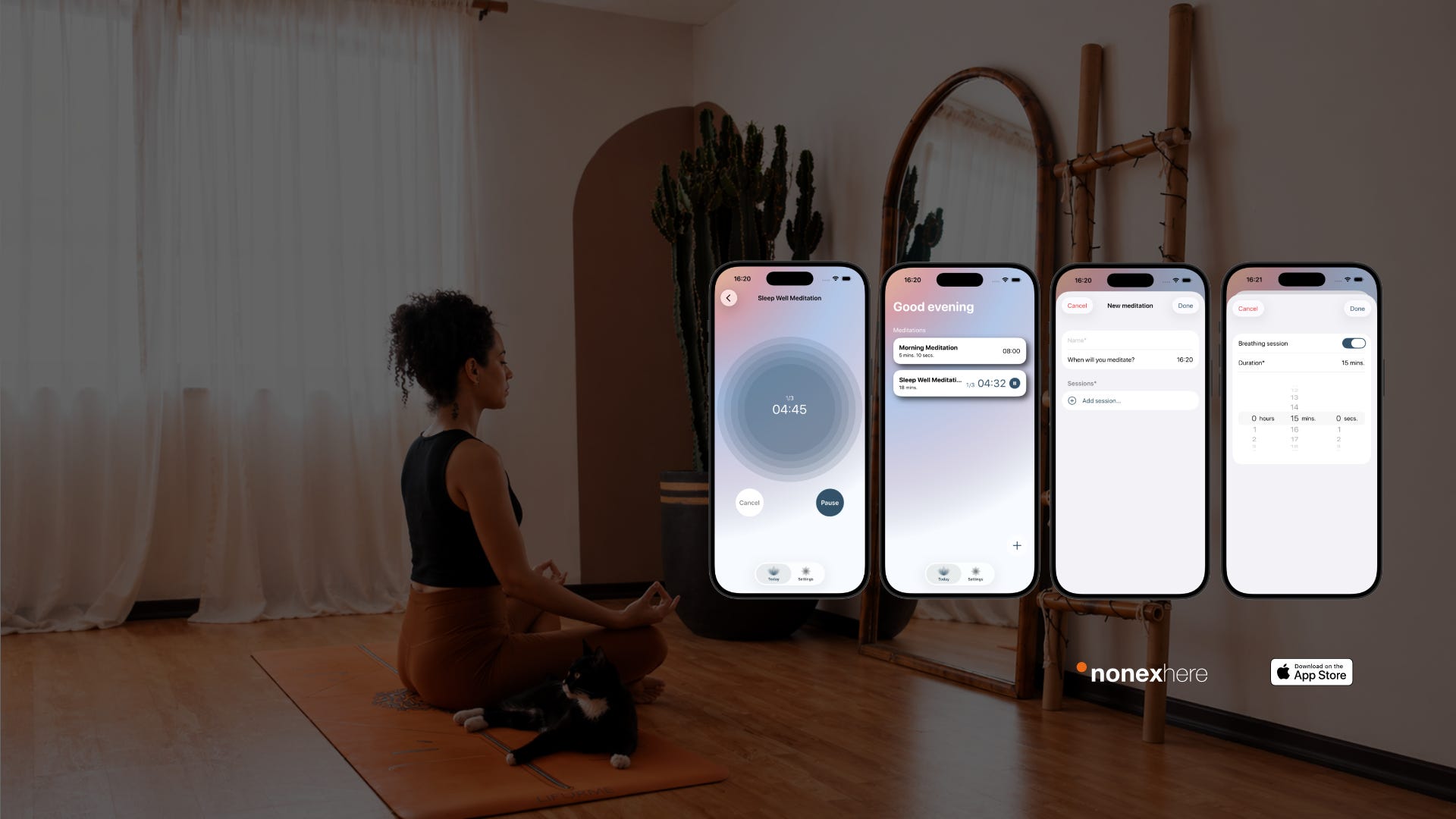
If you want to explore a more minimal and distraction-free approach, you can download ImagineHere from the link below.
How can you use a meditation timer app effectively?
Using a meditation timer app well is less about features and more about approach. The goal is not to optimize the experience, but to make it sustainable.
A good starting point is to keep sessions short and consistent. Instead of aiming for long durations, it is more effective to choose a length you can repeat daily without resistance. Over time, this builds familiarity and ease.
It also helps to treat the session as a fixed container. Once you start, you commit to staying until the end, without checking the time or adjusting the duration. This creates a sense of trust in the process.
A simple approach works best:
Choose a short, realistic duration.
Sit at the same time each day if possible.
Let the timer run without interaction.
Notice how you feel when it ends.
Over time, this becomes less of a task and more of a rhythm.
What are common mistakes when using meditation timer apps?
Many people approach meditation with a productivity mindset, and this often leads to unnecessary friction.
A common mistake is setting sessions that are too long. This creates resistance and makes it harder to return the next day. Another mistake is frequently changing the duration or experimenting with too many settings, which prevents the formation of a stable habit.
There is also a tendency to treat meditation as something to “complete.” When the focus shifts to finishing the session rather than experiencing it, the quality of the practice drops.
What actually works in real practice?
In real-world use, simple patterns tend to be the most reliable. People who maintain a consistent meditation habit usually keep their setup minimal and predictable.
Fixed session lengths, repeated daily, create a sense of familiarity. The mind begins to recognize the pattern, and starting becomes easier over time. In contrast, constantly changing apps, durations, or methods often leads to inconsistency.
Interestingly, adding more features does not necessarily improve the experience. In many cases, it does the opposite. Fewer choices make it easier to begin, and beginning is often the hardest part.
What does “meditation timer” mean in practice?
A meditation timer is not just a tool for measuring time. It functions as a small ritual structure that frames your practice.
It creates a clear beginning, a defined middle, and a gentle ending. This structure helps your mind transition into and out of the session more smoothly.
Over time, this repeated pattern builds familiarity. Meditation becomes less about effort and more about returning to something you already know.
FAQ: Meditation Timer Apps
What is a meditation timer app used for?
A meditation timer app is used to run meditation sessions without distraction. It allows you to focus fully while the app quietly manages time in the background.
Do I need a meditation timer app to meditate?
You do not need one, but it can help. A timer reduces interruptions and makes it easier to stay consistent, especially when building a habit.
Are meditation timer apps better than guided meditation apps?
They serve different roles. Timer apps support silent practice, while guided apps are more suitable for learning and instruction.
Can I use a regular phone timer instead?
You can, but the experience is different. Regular timers are more abrupt and can interrupt the flow of a session.
What features should a good meditation timer app have?
A good meditation timer app should be simple, unobtrusive, and reliable. Gentle sound cues, background operation, and a distraction-free interface are usually enough.
Why does all of this matter?
Meditation itself is simple, but showing up consistently is not. A meditation timer app does not make meditation deeper or more advanced, but it makes it easier to return to.
And in practice, returning is what matters most.
Conclusion: A small tool that changes the experience
A meditation timer app may seem like a simple utility, but in practice, it shapes how meditation feels. It removes uncertainty, reduces friction, and creates a clear space for you to begin and end.
What matters is not the timer itself, but what it allows you to do. It helps you sit without checking the time, stay without adjusting the process, and leave without interruption.
For many people, this small shift is what turns meditation from something occasional into something consistent.
If you are trying to build a practice that feels natural and sustainable, starting with a simple meditation timer app can be enough. Not because it adds more, but because it removes what is unnecessary.
And in meditation, that is often what makes the difference.