



The way professionals introduce themselves has evolved. As work becomes increasingly remote, mobile, and digital-first, the traditional paper card is being replaced by a more flexible alternative: the digital business card.
Today, freelancers, founders, consultants, and remote teams rely on digital business card apps to share contact details instantly, update information in real time, and maintain a consistent professional presence across borders.
But with so many tools available, which digital business card app is right for you?
This guide explores the leading digital business card platforms in 2026, compares their positioning, and helps you understand how to choose the best digital business card for your workflow.
What Defines a High-Quality Digital Business Card?
A digital business card is more than a contact page. At its core, it is a dynamic professional identity tool that replaces printed cards with a shareable, updatable, and mobile-friendly profile.
If you’re new to the concept, you can explore our complete guide to digital business cards for a deeper breakdown of how they work and why they are replacing paper cards.
The best digital business card solutions typically include:
A flexible digital business card maker
Real-time information updates
A digital business card QR code for instant sharing
Online access across devices
Design customization aligned with personal branding
Many professionals begin with a free digital business card to explore the concept. Over time, as networking needs grow, they often look for the best digital business card free solution that allows deeper customization and scalability.
Blinq Digital Business Card
Blinq is widely recognized in the digital business card space for its simplicity and ease of use. It enables users to quickly create a profile and share it via QR code, link, or NFC-supported interactions. The setup process is streamlined, which makes it appealing for professionals who want a straightforward digital business card app without a steep learning curve.
Blinq works particularly well for users seeking immediate functionality. However, professionals who prioritize advanced customization or multiple identity management may eventually look for additional flexibility. In many digital business card reviews, Blinq is described as a reliable entry point into digital networking.
HiHello
HiHello positions itself as a robust digital business card platform, often appealing to teams and enterprise environments. It offers structured profile management, branding consistency, and scalability for organizations that want centralized control over employee cards.
For individual freelancers or digital nomads, HiHello may feel more comprehensive than necessary. While it excels in structured environments, some solo professionals prefer lighter digital business card apps that prioritize simplicity over organizational complexity.
Mobilo
Mobilo blends physical NFC-enabled cards with digital profiles, creating a hybrid networking experience. This approach appeals to professionals who still value tangible interactions while integrating digital follow-ups.
Its ecosystem can be especially useful in sales-driven or corporate settings where CRM integration plays a key role. However, for users who prefer a fully online digital business card solution without hardware components, Mobilo may introduce unnecessary layers.
Dot
Dot offers a visually modern digital business card experience and focuses heavily on brand presence. Its interface is clean and mobile-first, making it suitable for networking events and quick exchanges.
Like other platforms in this category, Dot supports QR-based sharing and online profiles. Professionals comparing digital business card apps often evaluate Dot based on design aesthetics and brand alignment rather than deep workflow integrations.
Fluer: Digital Business Card
Fluer positions itself as a minimal and visually polished digital business card app. It emphasizes clean layouts and simplicity, making it accessible for professionals who want an uncomplicated digital identity solution.
Its structure supports QR sharing and standard profile features, making it suitable for everyday networking scenarios. For users who prioritize advanced customization or multi-role management, the feature set may feel more streamlined than expansive. Fluer tends to attract users who prefer a balance between design clarity and ease of use.
business card SimpleApp
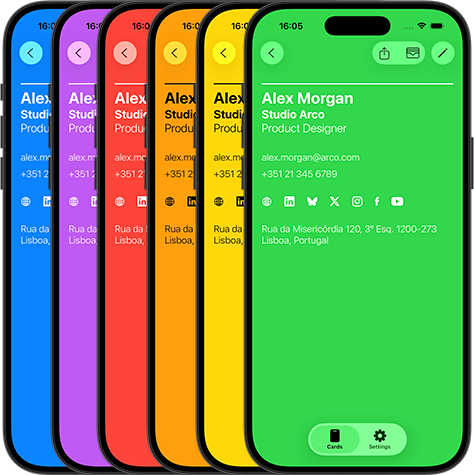
business card SimpleApp takes a digital-first approach centered on flexibility and clarity. Designed for independent professionals, freelancers, and digital nomads, it focuses on customizable card creation without overwhelming the user with unnecessary complexity.
The app allows users to generate a digital business card QR code, create multiple cards for different professional roles, and update details instantly. Integration with Apple Wallet adds practical accessibility, enabling fast sharing without navigating through multiple screens.
Unlike more rigid templates, business card SimpleApp supports adaptable themes that make it easier to align your digital business card with your evolving professional identity. For users exploring a free digital business card app before committing to advanced features, it offers a lightweight starting point while maintaining room for growth.
Free Digital Business Card Apps: Are They Enough?
A free digital business card can be sufficient for early-stage freelancers, students, or professionals experimenting with digital networking. Basic sharing functionality and QR generation are often included in free tiers.
If you still have questions about how digital business cards actually work in practice, you can explore our detailed Q&A guide where we break down the most common questions professionals ask.
However, the best free digital business card solutions typically impose limitations on branding control, number of cards, or advanced features. As networking becomes more central to professional growth, flexibility becomes more valuable than cost alone.
Choosing between a free digital business card and a paid upgrade ultimately depends on how actively you network and how central your digital identity is to your work.
How to Choose the Best Digital Business Card for Your Workflow
Selecting the right digital business card app depends on context.
Freelancers and consultants often prioritize:
Simplicity
Multi-role support
Fast QR-based sharing
Clean design
Sales professionals may look for CRM integrations and tracking. Teams may require centralized management. Digital nomads typically prefer lightweight, fully mobile solutions that work globally without additional hardware.
In our digital nomad toolkit guide, we also break down the essential apps and systems that support location-independent professionals.
Whether you refer to it as a virtual business card, electronic business card, or online digital business card, the objective remains the same: share business card information instantly, professionally, and without friction.
The Future of the Digital Business Card
The digital business card is no longer a trend. It is becoming a foundational networking tool in a mobile-first professional landscape. This transformation didn’t happen overnight. We previously explored the historical journey from paper cards to modern digital identity systems.
As careers grow more fluid and global, digital identity must remain flexible. A well-designed digital business card supports real-time updates, reduces paper waste, and ensures that your professional presence is always accessible.
When comparing digital business card apps, the best solution is not necessarily the most complex one. It is the one that aligns with how you work, connect, and grow.